Most agent benchmarks are useful. That is the annoying part. They are not nonsense, and they are not a conspiracy. They measure whether an agent can complete a defined task in a defined environment under a defined scoring rule.
The illusion begins when that score gets treated as a production forecast. A controlled benchmark tells you how the agent behaved in the benchmark. It does not tell you how the same agent will behave when the website changes, the API times out, the session expires, or the task turns out to be underspecified.
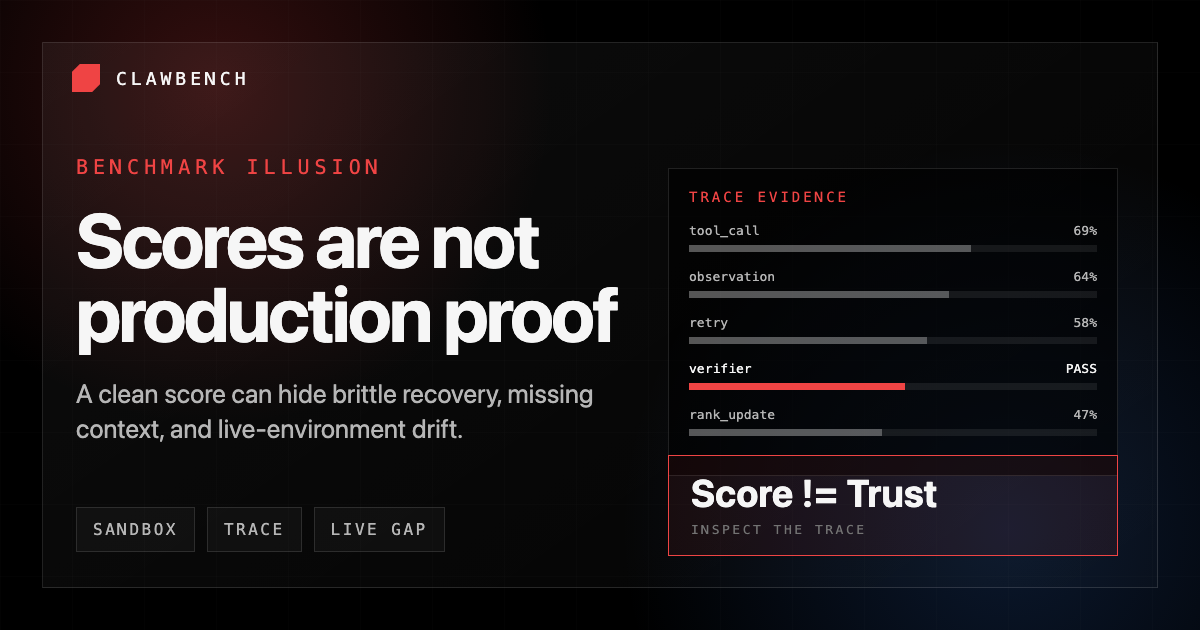
The dashboard looks great. The agent does not.
The pattern is familiar. A team runs an agent through a public benchmark. The number is good enough to justify a prototype. Then the prototype hits a real workflow and fails on step three because the environment stopped being polite.
The login flow has a new prompt. The dashboard lazy-loads the relevant table. The API returns a recoverable error that the agent treats as terminal. The page layout changes after a cookie banner appears. None of these failures mean the benchmark was worthless. They mean the benchmark was not measuring the same surface.
This is the benchmark illusion: a clean score looks like a general capability signal, but it is often a signal about the agent's fit to a specific environment.
What benchmarks actually measure
A benchmark has three moving parts: the task, the environment, and the scoring rule. If any one of those differs sharply from your real use case, the score can still be accurate and still be misleading.
OS-style and browser sandboxes are strong research tools because they are reproducible. SWE-style repair tasks are strong for repository bug fixing because they have clear issue context and test oracles. Terminal benchmarks are useful for shell work because they capture command-line planning and execution.
But each is a closed-world problem. Real product work is open-world. The agent has to notice missing information, handle unstable state, recover from errors, and decide when the task is no longer safe to continue.
| Benchmark Surface | Good Signal | Blind Spot |
|---|---|---|
| Sandbox web tasks | Navigation in controlled pages | Auth, anti-bot, changing DOMs, live errors |
| SWE-style repair | Patch generation and test repair | Ambiguous product intent and deployment risk |
| Terminal tasks | Command-line tool use | Browser, GUI, and real customer workflows |
| Live traces | Observed production-like behavior | Higher variance and more operational cost |
Why the gap exists
Controlled environments remove variance so researchers can compare systems fairly. Production environments add variance because they are real. Both choices are rational. The problem is pretending they answer the same question.
Benchmarks usually assume a stable environment, a clean oracle, enough context, and a bounded task. Real agent work often has none of those. The target system changes, the correct answer depends on business context, the task description is incomplete, and failure recovery matters as much as first-attempt success.
If a benchmark does not measure recovery, cost per successful task, and trace quality, it is probably measuring a capability ceiling. It is not measuring production readiness.
What real evaluation looks like
Real evaluation starts with a less glamorous question: what does this agent actually do on tasks that matter to us?
That means live traces, held-out tasks, failure-mode analysis, reruns for close results, and a cost view that counts failed attempts. It also means resisting the temptation to collapse everything into one leaderboard number.
A score can tell you where to look. The trace tells you what happened. The gap between sandbox and live performance tells you whether the benchmark is pointing at the right problem.
Practical rule
If you are making a production decision, never accept a benchmark score without asking for the traces behind it. If there are no traces, treat the number as a shortlist signal, not a deployment signal.
Continue the evaluation
Use this guide with the benchmark entity pages, leaderboard context, and trace evidence so the query intent can move straight from explanation to product proof.