 ClawBench
AI agent evaluation is messy because agents are not single-output models. They plan, call tools, navigate environments, recover from errors, and sometimes make things worse before they make them better.
A good evaluation framework respects that complexity without turning into theater.
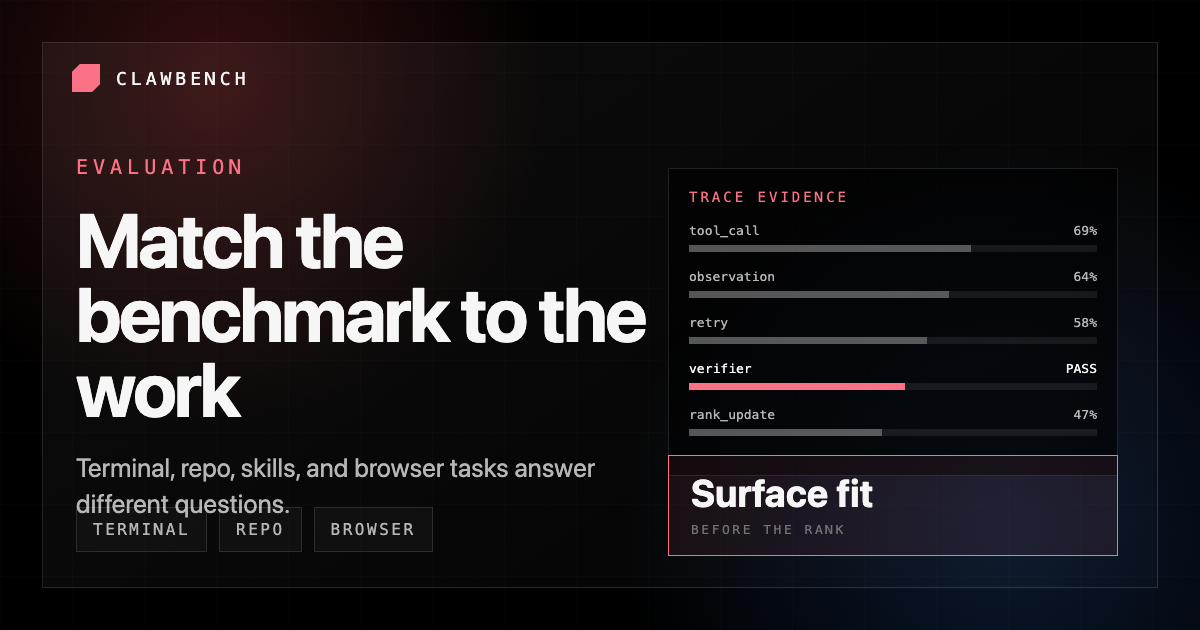
Match the benchmark family to the work
Terminal Bench can tell you whether an agent can use a shell. SWE-Bench Verified can tell you whether it can repair repository issues with verified outcomes. SkillsBench can tell you whether reusable procedural skills are being applied. Web Tasks Benchmark can tell you whether browser workflows survive interaction.
Each family is useful. None is universal.
| Work Surface | Benchmark Fit | Question Answered |
|---|---|---|
| Shell workflow | Terminal Bench | Can the agent plan and execute commands? |
| Repo repair | SWE-Bench Verified | Can the agent produce a valid patch? |
| Reusable behavior | SkillsBench | Can the agent invoke procedural knowledge? |
| Browser workflow | Web Tasks Benchmark | Can the agent navigate and recover on web surfaces? |
Evaluate the path, not only the output
The final answer is important. It is not the whole result. An agent can land on the right answer through a risky path, and that matters for production use.
Trace review shows whether the agent made a focused attempt, stayed inside the task, used tools responsibly, and verified the result. It also shows where failures cluster.
Separate capability from reliability
Capability asks whether the agent can do the task. Reliability asks whether it does the task consistently, within budget, and without creating unacceptable side effects.
Teams often over-index on capability because it is easier to demonstrate. Reliability is harder because it needs reruns, held-out tasks, and failure analysis.
Run a portfolio, not a single test
A single benchmark can create false confidence. A portfolio makes the blind spots visible. Combine public benchmarks, domain tasks, live validation, and trace review.
The right portfolio depends on the product. A coding assistant needs different evidence from a browser automation agent. A customer-facing agent needs stricter safety and recovery checks than an internal batch tool.
The evaluation loop
Run a baseline. Inspect the trace. Identify one failure mode. Change one variable. Rerun. Validate on held-out tasks. Check whether the change improved the real behavior or only the visible score.
That loop is not glamorous. It is how agent systems get less fragile.
Practical rule
Do not ask "is this agent good?" Ask "which surface did we test, what evidence did we capture, and what failure mode remains?"
Continue the evaluation
Use this guide with the benchmark entity pages, leaderboard context, and trace evidence so the query intent can move straight from explanation to product proof.